
Scout portrait in progress - start to finish

July 29
I'm starting a triple portrait of Border collie “Scout”.
The following pictures show how I go about designing a complex portrait with multiple depictions of the individual….from the 60 photos of Scout that Annette sent to me.
Scout is a registered Therapy Dog,
and also does barn hunt and is a dedicated Frisbee-fetcher.
1
This is my outline drawing on a sheet of “Flannel Grey” Canson paper. It took 11 days of working with Annette on a layout design, to get to the point where I was ready to draw this composition on the actual art paper.
The following images show how I work out a complex composition like the one I am using for Scout’s triple portrait. I used to do all this in my head, or with rough sketches, but now I use Photoshop to arrange the pieces in different configurations until I find the right composition. That has to be done in collaboration with the client, following their wishes for the portrait. That process can take days. There is a lot of back-and-forth communication between artist and client during this phase. Each day I send new layouts, and then develop them further based on the client’s feedback.

2
Annette had seen this portrait I did of Brenna, a triple portrait, and said she wanted one like it of Scout. She thought Scout’s portrait would look just like this, with two head studies and the sheep scene. Annette adopted Scout at age 5 and prior to that he worked in herding. Annette wanted this scene because it was so pretty, she said, even though she has not done any herding with Scout. Scout and Annette have their own accomplishments: they are a Therapy Dog team, and Scout also does barn-hunt and is a dedicated Frisbee-fetcher. So I guided Annette toward a portrait design that would be unique to Scout. I assured her it would be just as beautiful as Brenna’s portrait.

I start with my client’s wishes, first and foremost. Two head studies and an action scene.
3
Before I start working on a layout I ask my client to send me all the photos of the subject that “speak to them”. That is the raw material I’ll be using to build the portrait design. Annette sent me 60 photos of Scout.
Putting together a layout for a complex portrait with more than one portrayal of the subject, using the existing photos the client sent, is like putting together a puzzle. A puzzle where I don’t know if I have all the right pieces, or how (if) they will fit together, and I don’t know what the final picture is supposed to look like.
First, I have to find my puzzle pieces.

4
I began by gathering the photos of Scout’s head I thought would make the best portrait. If it was a full-body photo I cropped to just the head, and sized them so all the heads are the same size for easier comparison. This is what I sent to Annette. The ones in the second row are “second choice” photos - I like the expression, but in one he is wearing a Santa hat and the other one was low-resolution and poor detail.
Annette had already told me she doesn’t like photos of Scout where his mouth is open and tongue is hanging down, and I ruled out several of those. (But I just had to include # 2 where he is smiling. I was well aware that was MY ‘Like’, not my client’s.)
Annette responded, “I especially like # 3 - he looks so natural and I think it is more pleasing than an intense frontal face. Before seeing what you have done, # 1 was my favorite. Number 4 also has a natural and relaxed (not so "posed") look to me. I defer to your experience but I think a relaxed pose and not staring into the camera looks nicer.”

5
Next I gathered the most promising Frisbee shots that I felt were good “ingredients” for an appealing artwork.
Annette said, “Of the frisbee shots I like the ones on the ground better than the jump. I also don’t care for the football shot as well - he looks mean & the swimming shot disguises his beautiful body.”
That ruled out the three photos on the left. So I had the three photos on the right/bottom to work with. Some are very small without good details. But that’s what I have to work with.

6
Then I chose the most visually appealing barn-hunt photos. When I sent this to Annette for feedback she said, “The barn hunt are all good - hard to pick among them!”

7
Next, designing the layout from those puzzle pieces.
I have 10 puzzle pieces: 4 heads, 3 barn-hunt photos, and 3 Frisbee photos.
All the head photos and barn-hunt photos were taken by pro photographers and have excellent detail. It’s a luxury to have very good-quality photos to work with. The Frisbee shots were taken at a distance with a phone and don’t have good detail.
First I started with a barn hunt photo that I thought was the best one to use: a depiction of Scout’s beautiful, trim body and shiny coat, and tried different head configurations with it. I made 5 variations of that with different heads, also trying different paper colors. (I’m showing you two of them.)
The one on the right is on a straw-colored background paper color.
8
Then I tried the running Frisbee photo, again with different combinations of head studies, and some different background paper colors. I made 5 variations of those. Three are shown here.
A layout on grey paper….green paper….and sky-blue paper.
9
I had been pursuing Annette’s wish for two head studies, like my triple Brenna portrait she liked.
Next I tried one head study with two action poses: one barn-hunt and one Frisbee.

10
That made more sense to me. With the head study large and central.
I tried different variations of that. Moving my puzzle pieces around, in different configurations, and different sizes. I made 7 variations of that.

11
One was a horizontal format for the portrait (this one). A vertical shape worked better for most of the configurations I came up with.

12
Finally, on my 16th layout, I came up with this, and sent all of them to Annette.

She liked number 16 the best, but asked me to try the three-quarter view head of Scout rather than this frontal view. That was the winning ticket.
13
Next we discussed paper color, which will be the background behind the head study. The background behind the action figures will be straw-color and green for the grass. We were 10 days into the layout process at this point and paper color was the final decision.
I sent Annette 11 different background color suggestions. Six are shown here.

I mostly concentrated on neutral grey, and sent 4 different greys, 2 two on beige or brown, 3 different blues, and a green. Those were the Canson paper colors I considered that gave a harmonious color scheme to the whole portrait (with the gold straw and green grass) and which I would want to work on for this piece. I had to take into consideration not just what would look pleasing and fit with my client’s wishes, but from a technical standpoint what color paper would work for my artistic techniques. Each of the paper colors presented different pros and cons. On a green paper, the grass would be easy to do. On a warm beige paper the straw would be a piece of cake. On the blues the straw would be hard, to cancel out the cool blue with warm golden colors. An any of the blues, the green, or the beige/browns, I would have a struggle to get a good clear white for Scout’s coat and neutral greys in the black parts of his coat, since the paper color underneath would “tint” those pencil colors. Any of the 4 greys would work the best for portraying Scout - a black and white dog….but would be more work to do that green lawn and the straw in the two action scenes — because I would have to completely cover the grey to get the grass and straw to look right. There is little or no grey in either of those textures.
14
The final choice was Flannel Grey. I was very happy with that choice, it’s what I would chosen if the decision was left up to me with no input from the client.
Annette is very decisive. She knew exactly what she wanted when I presented her with choices, and responded to each round of layouts quickly. That made the whole process go quickly and smoothly.
It took two days to draw this outline drawing on a sheet of Flannel Grey Canson paper. Now I’m ready to get to work on Scout’s head-study with colored pencils.
🎨 Prismacolor pencil on “Flannel Grey Canson paper, 20 x 26 inches.
Commissioned by Annette Riehle.
Reference photos:
Barn hunt photos by Jackie Singer, head study photo by Faith Lyman, Frisbee photo by Donna Childs.
Scout portrait in progress 2
The first day’s colored pencil work on Scout’s head study.
Today I worked on his ear and started across the top of his head. Tomorrow I want to do his forehead and eyes. When I sent this pic to Annette and described that, she wrote:
“This is an education for me! I have no idea the ways that art pieces are created. I am enjoying learning about the process!”
It’s fun to share the process with a client who is interested in how the “magic” happens.

Scout portrait in progress 3
How I made an eye...
1
I usually start an eyeball by creating the eye structures that are around it - eyebrow, corner of eye, eyelids, and shape of the eye socket - and work inward, first adding the white parts of the eyeball (which are usually minimal in dogs)…and continuing to work inward until I have outlined the iris (the colored part of the eyeball). Most often that is outlined with black or a dark color.
I make sure that outline of the iris is perfectly round. (Not counting any part of it that may be hidden by eyelids.) Then I do the iris and pupil (the black “hole” in the center) all at once. That is the most nerve-racking part of any portrait.

And sometimes the colors of that part of the eyeball - the iris and pupil - can be surprising....
2
I create the iris (the colored part of the eye) and pupil, following what I see in the reference photo. You must follow what you actually see…what is there in the photo, not what you think is there. Note that the pupil is not black, or anything close to black. The lower curve of the iris is not orange, or rust. It is mauve. These colors are a result of reflected light on the shiny eyeball.

3
Now I’m working outward (toward the left side of the face) from the lower eye socket, filling in the black coat. There are large areas of solid black on that side of the face.
First I put in some of the lighter strands (Scout’s upper cheek). They don't look lighter on this light grey paper, because they are darker than the paper.

4
Then I go dark between/around and over them - with dark greys, Sepia + Denim Blue (that makes the darkest grey possible, short of black), and Black pencil.

Some colored pencil artists believe you should only create black by building up multiple dark colors. I’m not afraid to go in with a black pencil, coloring it as solid as I possibly can into the paper tooth. I don't see any point in spending time layering multiple colors to get black… If you can just use Black.
5
These five pictures were one day’s work.

Scout portrait in progress 4
Scout’s other eye finished. When I sent Annette an in-progress picture of the first eye finished, she wrote this:
“I can't even find words to describe the feeling I got just looking at the eye. It really felt like Scout was looking at me - as he always does. It is truly emotive and comes alive the longer I look at it. I am continually amazed as I learn more about the ethereal aspect of your work. I am sure there are many artists who try to put themselves into their work but I believe you succeed in ways that are truly spiritual. You are capturing the essence of Scout that brings me to tears. I can't imagine how overwhelming it will be to see the full depiction of him "at work" and looking out with his full attention in those expressive eyes. I am sure you hear this often as you are able to capture the non-physical aspect of the family - dog and human. I think I need to practice some of your techniques in sewing for my family instead of just picking things that I like to make - I should ask about the little girl I am sewing for.”

It’s a great privilege to create art for a client who truly “gets it”, what we artists put into our work.
This is how the whole artwork looks now:
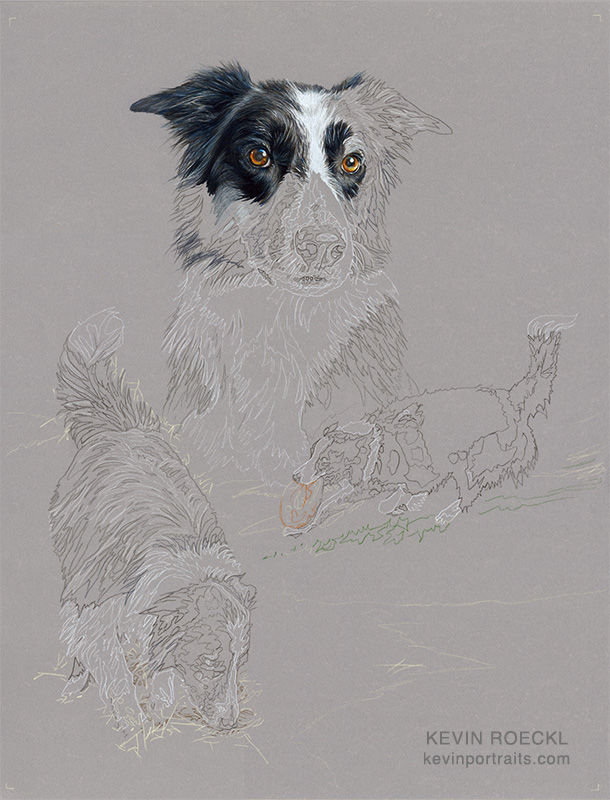
Scout portrait in progress 5
This is my favorite “in progress” pic so far, with his shiny black nose popping out of the paper!
There are lots of detailed shapes involved in a dog’s nose.
And a range of values from white to black.
1
A dog’s muzzle has lots of small detailed hairs. I started out in the studio this morning working down the white blaze from between Scout’s eyes, adding the black hairs on the side of his muzzle on the left where they meet the white portion.
Then I put in the white and light-grey whiskers and small hairs that helped me precisely locate the edges of the nose-leather (the black nose). Once I made the edges of the black nose, I filled in the interior, completing the nose.

2
A dog’s nose is “black”, but when you look at a good reference photo you can see that there are all sorts of lighter and darker values in it. The light reflecting off the shiny “nose leather”, and the darker shadows in the convoluted shapes of the nostrils. There is very little/I used very little actual black in this part of the drawing.
I used the full range of warm greys, from lightest to darkest, the full range of cool greys from lightest to darkest, blue-grey, dark sepia brown, very dark blue, and of course black, and white, pencils.

3
Scout’s head study is really starting to emerge 3-dimensional.
When I sent this to Annette, she responded,
“I am so amazed - I feel like I could reach out and pet him!”

Scout portrait in progress 6
Almost finished with Scout’s head. I am not going to do any of his neck and shoulders until I complete the two action poses - Frisbee, and barn-hunt. You can see part of them sketched in the lower corners.
Both of those will have background scenes: grass and straw bales, respectively. I’ll use a watercolor underpainting to create the green and gold background colors around those two figures. Then add the grass and straw detail with colored pencils. I will fade Scout’s shoulders down into those scenes after they’re completed.

My followers know that I sometimes use a watercolor wash to tint the paper in certain areas. Usually that is the first step that I do before I start on the piece with any colored pencils. Typically I would have done that before starting Scout’s head study. Why did I decide to do it in a different order this time?
Because large areas of watercolor underpainting, like these two action scenes will require, buckles the paper. Canson Mi-Teintes is a pastel paper, it’s not made to handle water. That would have made big ripples and hills/valleys in the paper after it dries. Before I could do any pencilwork over that, I have to press it flat under weights for two days.
I didn’t want to take time out to wait for that. I was excited about this portrait and wanted to jump into Scout’s head study! So I’m doing it in a different order this time. The watercolor washes will be next.
Scout portrait in progress 7
How I made the underpainting for Scout’s portrait.
1
This is how the artwork looked before I started. It’s on “Flannel Grey” Canson paper. I am going to make an underpainting with golden-brown watercolor around the barn-hunt figure (lower left) and green watercolor around the running Frisbee figure. For straw-bales and grass, respectively.
I completed Scout’s head study with colored pencil down to his chin. But not any further, because I will make a watercolor wash that fades upward into his neck and shoulder area. Later I will finish the rest of the neck and shoulders with colored pencil OVER the watercolor.

2
I’ll mask off the figures so I can do a smooth wash without stopping to paint carefully around the details of Scout’s figures with a fine brush. That would be slow going and the wash would dry up in places and become blotchy. Mi-Teintes is not watercolor paper, it's very absorbent. It’s challenging to get a smooth wash on this paper even when I work fast.
There are many ways to mask off an area of paper.
An art term for masking materials is "frisket". You can get frisket fluid, frisket film, etc.
I'm using translucent adhesive film. I can see the outlines of the figures through it, so I know where to cut.

3
I cut a piece of film larger than the figure and press it down, completely covering the figure. Then I start cutting away the film around the figure.
I cut the film very carefully with a sharp (brand new) X-acto knife blade. I have to cut through the film, which is a little tough, but NOT cut into the paper. It requires very precise pressure with the blade.

4
Cutting the film and peeling away the excess.

5
Film cut on the Frisbee figure.
I have fairly simple shapes to mask off. I’m not cutting out every wispy hair on Scout. I’ll make his wispy edges with pencil strokes over the watercolor background. If I had a lot of fine detail to mask off, I would use frisket fluid (masking fluid) and paint it on the figure with a fine brush, instead of cutting out this tough film.

6
In this pic you can clearly see the film covering the figures. The figures are protected and there is open paper around them.
Now I'm ready to put down a watercolor wash all the way across the background, in the lower half of the artwork. I don't have to worry about painting carefully around the figures. I can go right across them with a large brush.

7
Painting day.
I refer to my underpainting washes as “watercolor” because they are thinned a lot with water. Today I’m using liquid acrylic paint, thinned with water. I use it just like watercolors.
I mixed up 4 shades of green, and 4 shades of gold, from darker to lighter, and in varying degrees of watery-ness (more water added to the paint). In this pic you can see the bottles of paint I used on the upper right corner of my work table….and the foil-covered wells with the different mixtures. This picture was taken after I’d finished painting the green and gold watercolor washes on the artwork, going right over the masked-off figures. My brushes have been washed out and are standing upright in a plastic cup.
On the upper edge of my table is a hair-dryer used to dry paint swatches on a test scrap of “Flannel Grey” paper while mixing the paint. And paper towels that I used while working to swipe my brushes on and blot up extra water or paint on the artwork.

8
The background underpainting finished.
Note how I painted right over the masking film that covers the figures.
I used a smaller brush to add in some lights and darks on the gold while the paint in the lower portion was still wet. I put a wash of gold-colored paint down with a large brush, and then dash those lighter and darker strokes into it as fast as I can while still wet. Even so it dried while I was doing that. If I was working with watercolor on a good-quality watercolor paper, I would have gotten a much better “wet in wet” effect. But this is good enough, it gives me the right background color and will save me a lot of work trying to cover every speck of “Flannel Grey” paper with colored pencil when I make the grass and straw.
I will use colored pencil strokes to make grass blades and straw blades. Pencils work great for things like that, but not so well for big smooth areas of color. The fade-out of green above the action figures that goes up on both sides of Scout’s head study would have been hard to do smoothly with colored pencil. (The paper is buckled but when it’s flattened you’ll see how smooth that wash is there.)

9
I let the paper dry and clean up all the paint stuff.
Then I remove the masking film.

I love peeling up the film after the wash has been applied.
It's so satisfying!
10
With the film peeled off. Now I have that beautiful virgin grey paper for doing Scout’s black and white coat. It’s not tinted by the green or by gold/brown.

If I had done the wash over the figures without masking them off and protecting that grey paper, it would be hard to completely cover that underlying green and gold later with colored pencil. Colored pencil is a “transparent medium”, so that underlying color would give Scout’s coat a greenish, or brownish, cast. The “Flannel Grey” is the perfect base color for Scout’s glossy black and pristine white coat. Now you can see my strategy for protecting the figures.
11
Pulling up a tip of the masking film over the Frisbee figures with the x-acto knife blade so I can get hold of it.

12
I just love pulling up the film and revealing that clean grey figure, with my outline drawing still in place.

13
The whole artwork with the film peeled off.

Now I have that beautiful grey paper to do Scout’s figures, and background colors just where I want them. I’ll use colored pencil strokes to make grass blades (lighter and darker) on the green, and straw (lighter and darker) on the the gold. These areas of underpainting save me a lot of work as a colored pencil artist. I often use underpainting like this as the first step in creating background scenes.
14
The studio window open so the paper can dry really well.
Since this paper is not made for taking water-based media, water-based paint buckles the paper. I will press it under weights overnight to flatten it, before I continue working on the figures. I need flat paper to make smooth pencil strokes. Having bumps and bulges in the paper messes up my smooth hand motion when making those strokes.

15
Paper flattened and ready for the next step:

Scout portrait in progress 8
I’ve moved on to the second figure, an action pose - Scout running fast with his Frisbee. This one poses a dilemma: a blurry reference photo. Most people know me for my highly detailed, realistic style. I solved the challenge of using a reference photo that doesn't show any detail, by working in a different, more impressionistic style. The close-up of the pencil strokes in Pic 4 shows what I mean.
A professional artist friend of mine often refers to this look as "painterly”.
It doesn't look like a photograph.
It looks like a work of art.
1
Since the Frisbee photo I’m using is a low-resolution photo taken from across a field and doesn't have good detail, I plan to do it in a looser style. My usual style is highly detailed and photorealistic, with every hair and whisker accurately depicted. I work very slowly and deliberately. When I do my looser style, I work much more quickly, “dashing” the strokes down on the paper in a more impressionistic way. That works perfectly for Scout’s running Frisbee pose, where I want a feeling of speed and action.
I get myself set up in the studio on a day when I won’t have any interruptions to finish the whole figure, because I want to keep up my momentum in that style without stopping. For my studio music I wanted something fast-paced and energetic. It’s almost like I am dancing to my pencil strokes when I work. I needed the right soundtrack for Scout running fast with his Frisbee. I played a Spanish Guitar playlist, starting with Behzad’s “Journey”, then continued with Jesse Cook’s “Mario Takes A Walk” — Spanish guitar with clapping and some incredible guitar riffs — and then more Jesse Cook all the way through. Perfect for the speed and energy I wanted for the Frisbee picture.

2
Cookin’ with Jesse Cook! Fast pencil strokes and fast Frisbee action!
I never let up with my speed portraying this figure. The fast music helped me do that.

3
I broke a couple pencil points doing this. 😄 I get very vigorous with this style.

4
If you zoom in on the next picture, it shows how I throw down quick jots and dashes of color. Instead of taking care to carefully blend colors so they look photo-realistic, I dash on some brighter colors and just let them stand instead of blending them down more muted with greys and black. That’s one of the characteristics of this looser, faster style I do. I call it my “Little Jewel” style, because of these bright little jewels of color in it, like the red on the top of his neck and blues on the edge of his black coat. Blood-red on the lower edge of the Frisbee.

Instead of keeping my pencils sharpened to the sharpest point possible like I do when I’m portraying fine detail, with this style I use my pencils with dull, flat points, jotting the colors on the way an impressionist painter dabs on brushstrokes of color.
I was very pleased with how I captured
the expression of joy on Scout’s face.
5
I was pushing myself a bit by the time I got to the end, but I really wanted to keep up that momentum and do the whole figure all in one go. I am very happy with how it came out. I think I captured Scout's motion and excitement. And I think I caught that gleam in his eye!
You know that I made an underpainting of green for the grass around this figure, masking off the two action figures to leave the virgin grey paper. Now you can see the results of doing the black and white dog with colored pencil on the grey paper - rather than over green underpainting - and how that made him pop out of the green. If I had made the underpainting across the figure without masking it off, and then put colored pencil over that, Scout’s white and black areas would have had a greenish cast. Especially his white areas. They would have been light green.

Here’s what Annette wrote after seeing this:
“I like the way his frisbee pose seems to be moving - feels like he will shoot across the page! He is "faster than a speeding bullet' as the old Superman intro used to say. His body seems to be built for this movement and this pose really shows it ...hair flying and head leading the drive! I love the accuracy of the depiction of the white in his coat which really is WHITE!!”
“Scout”
Commissioned by Annette Riehle.
🎨 Prismacolor pencil on “Flannel Grey Canson paper, 20 x 26 inches.
From reference photos by Faith Lyman, Jackie Singer, and Donna Childs.


Comments